Once a year, the councils of Lafayette, Moraga, and Orinda sit down in the same room. At this year's joint meeting, held July 16 at Saint Mary's College, a striking amount of the agenda pointed at a single question: when Lamorinda needs to move a lot of people quickly, will the roads be ready?
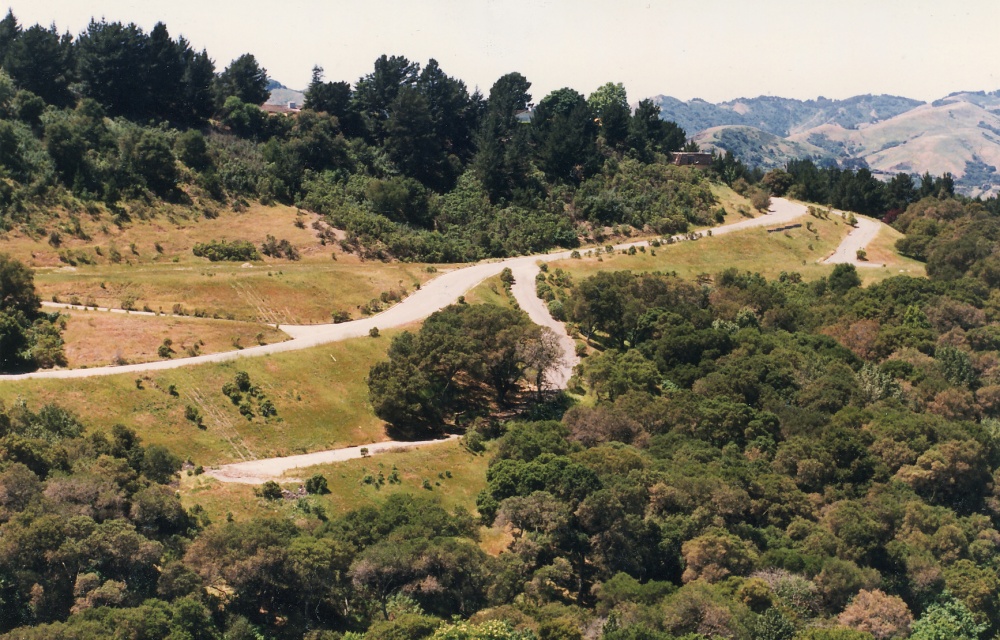 A winding lane through the Orinda hills. Narrow routes like this are why evacuation capacity is a community-scale problem. Photo: Andwhatsnext via Wikimedia Commons, CC BY-SA 3.0.
Between a countywide evacuation study, a traffic signal overhaul, a new trail designed to double as emergency access, and two wildfire bills moving through Sacramento, this was a meeting worth paying attention to. Lamorinda Weekly's Jennifer Wake covered the full session, which also included BART funding and e-bike legislation. Here is the fire-readiness half of the story, and what it means for your household.
The county is studying how we'd all get out
Contra Costa Transportation Authority Executive Director Tim Haile briefed the councils on the Countywide Emergency Evacuation Study now underway. CCTA secured a $1.49 million Caltrans climate adaptation grant to build it, and the scope is ambitious: evacuation compliance assessments for all 19 cities and towns plus unincorporated areas, and a capacity, safety, and viability analysis of the county's evacuation routes.
Two state laws sit behind the study. SB 99 requires cities to identify residential areas without at least two evacuation routes. AB 747 requires evacuation route capacity and safety analysis in local safety planning. And the countywide framing is not an accident: CCTA's own announcement notes that the county's multi-jurisdictional hazard mitigation planning identified that climate and other hazard risks may result in evacuations using routes that span several cities. If a ridge fire in Orinda sends traffic through Moraga and Lafayette, the plan needs to treat those roads as one system, because the fire will.
Smarter signals, including 56 intersections here
Haile also presented CCTA's roughly $5 million Smart Signals project, which will upgrade 365 traffic signals across Contra Costa County, including 56 signalized intersections in Lamorinda. Connected signals can be re-timed as a system during an emergency, which matters on corridors like Moraga Road and Camino Pablo where a few key intersections set the pace for everyone behind them.
"We want Lamorinda to be a model for what this connected system can look like," Haile told the councils. Per Lamorinda Weekly's report, construction is expected to start in spring 2027 and the system should be operational by fall 2027.
A trail that becomes a fire road when it counts
The quietest item may be the most interesting. Moraga Public Works Director Nate Levine and Orinda City Engineer Siva Natarajan presented a joint project, funded by a $508,000 federal Safe Streets and Roads for All grant awarded in December 2025, to plan a 10-to-12-foot-wide trail that can be converted to emergency vehicle access during an evacuation.
Dual-use infrastructure like this is a big deal in a place with narrow, winding roads. A trail wide enough for a fire engine means fire crews can move in while residents move out, without competing for the same lane. The timeline is long (a draft report is expected in late 2027 or early 2028), but the direction is right.
Two bills to watch in Sacramento
Casey Elliott of Townsend Public Affairs walked the councils through two wildfire bills, both introduced February 20, 2026 and still working through the Legislature. Neither is law yet, and both could change before a final vote. They're worth watching anyway.
AB 2513 (Petrie-Norris) would let the state directly award "regional landscape grants" to regional entities carrying out fire-resilience strategies, and it broadens CAL FIRE's local assistance grant program. The eligible activities list reads like a Lamorinda wish list: vegetation management along roadways and driveways, ignition prevention, defensible space compliance help, evacuation route improvements, and creating new Firewise USA communities. Local agencies and fire safe councils are among the eligible grantees, which is the basis for Elliott's point that Lamorinda agencies could tap these grants for regional fuel work. You can track the bill on the Legislature's site.
AB 2517 (Calderon) is about the fire hazard severity zone maps that sit underneath so much of fire policy. Those designations influence defensible space enforcement, ignition-resistant construction requirements under Chapter 7A, and what gets disclosed when a home is sold. For local responsibility areas, which include incorporated communities like Lafayette, Moraga, and Orinda, the bill would require the State Fire Marshal to publish draft maps, the underlying data, and the methodology at least 180 days before finalizing them, hold a stakeholder workshop, take 30 days of written comment, and respond to local agencies' data-accuracy comments. It would also lock in a five-year review cycle for these zones starting by January 1, 2030. In plain terms: more notice, more transparency, and a predictable schedule for the maps that decide which rules apply to your parcel. Bill text is here.
What this means for your household
Every item above is real progress, and every item is also years out. The evacuation study will take time to finish. Smart Signals aims for fall 2027. The trail report lands in 2027 or 2028. The bills are still bills.
Personal evacuation readiness is the part you control now, and it is the part that makes any future infrastructure work better:
- Know your routes before you need them. Not just the way you always drive, but the second and third ways out of your neighborhood. Our Lamorinda evacuation routes playbook walks through them town by town.
- Get the alerts that tell you when to go. Evacuation orders are issued by zone through the Community Warning System and Genasys Protect (formerly Zonehaven). Our emergency alert systems playbook covers what to sign up for and what each alert level means.
- Be ready to leave without packing. A staged go-bag turns a frantic 30 minutes into a calm five. The 72-hour go-bag playbook has the checklist.
If you want to weigh in on the projects themselves, the full tri-city meeting is available on YouTube, and both bills accept public position letters through the legislative process.
To see what CAL FIRE's hazard map says about your address, use our fire hazard zone check. That is a fire hazard designation: it is not your evacuation zone (look that up on Genasys Protect) and it is not a measure of how prepared you are. Our Home Fire Readiness Score is not open yet; you can join the notification list on that page.
Continue Learning
Playbooks
Insights
- What MOFD's Prescribed Burns Mean for Your Neighborhood
- Strength in Numbers: Why Neighborhood-Scale Preparedness Wins
Sources: Lamorinda Weekly, "Lamorinda councils hear about transportation projects, local legislation during annual tri-city meeting" (Aug. 12, 2026) · AB 2513 bill text, leginfo.legislature.ca.gov · AB 2517 bill text, leginfo.legislature.ca.gov · CCTA press release on the Countywide Emergency Evacuation Plan grant
This article is published by Lamorinda Ready for educational and informational purposes only. It does not constitute professional, legal, engineering, or safety advice. AB 2513 and AB 2517 are pending legislation as of August 2026 and may change or fail to pass; project scopes and timelines for the CCTA evacuation study, Smart Signals, and the Moraga-Orinda trail are based on Lamorinda Weekly's August 12, 2026 report of the July 16 tri-city meeting and may shift. Consult official agencies (MOFD, your city, CCTA) and qualified professionals before making decisions about your home, property, or evacuation planning. In an emergency, follow official alerts and the guidance of emergency services. When in doubt, call 911.